NOTES ON BOXING GLOVE CANCERS
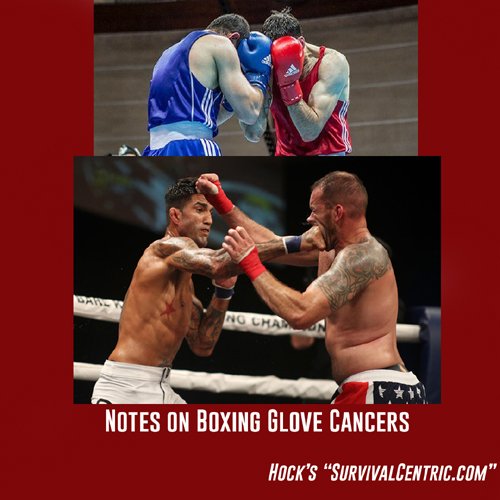
It pains me to write this, but I think it will pain some of you more eventually not to read and understand this. It’s about the “boxing glove cancers.” You see in many ways without this knowledge-discussion on punching you don’t now if you are either a sport boxer, or a bareknuckle self-defense puncher. The glove is a yardstick for this.
A good practitioner should know their mission and the difference. Both should be able to articulate and explain how this big boxing glove cancer manifests in training and reality. But numerous instructors and systems you blindly trust don’t. This does not speak well of their wisdom. Their mission. Or yours.
The glove and bareknuckle related recipe of which I speak here is only hand – wrist – forearm. Three part harmony. We are not migrating out to body position and movement etc., all of which actually puts more pressure on the recipe. In the self-defense, crime and war fighting, we the puncher will not have big, padded gloves. Will not have a wrapped wrist and lower forearm. We will have to make a bare, solid, tight, clenched fist. Meanwhile, a boxer-boxer and related “muscle-memory” has a big, padded glove, wrists wrapped, and does-not, cannot make a solid fist inside a boxing glove. Remember the night Mike Tyson punched that jerk in a Las Vegas bar. Mike knocked the guy into the next dimension…but broke his hand.
This is not an argument for palm strikes over punching. Another topic. In fact these days we see a plethora of successful, multiple bareknuckle punches on the internet. Granted we don’t see the after-camera, aftermath of said punches, but from what we see these gloveless punchers do okay. There will always be anecdotal tales for and against punching in general. (Remember not to punch the “bicycle helmet area” of the head-skull. Aim lower)
Gloveless, classic martial arts worried about “fist-bone density-punch-hand-survival” and have exercises and equipment to build density. Makiwara pads etc. But you just can’t do too much of that else eventually “destroy” your hands (as some old-timers have done, turning their hands into arthritic-ridden, Klingon mitts. I have a few old-timer friends that cannot hold a cup of coffee in their hand from “karate arthritis.” But some building of fist bones density is smart. (Same with the whole body and bones.)
Bag time. In Krav Maga and combatives training, we are supposed to be fighting bareknuckle, yet some versions of those reality systems insist on excessive boxing glove time. Like on heavy bags. Why would survivalists spend endless hours on heavy bags with big boxing gloves? I see reality classes where for 15 minutes or so of an hour, people don big boxing gloves and hit heavy bags. Why not do this bare-knuckle? After all, this is Krav. This is crime and war fighting combatives. Or, at least why not MMA gloves? Much closer to bare hand.
Here’s a bag idea I enforce. Spend a certain amount of time, hitting the bag bareknuckle, developing a closer feel for proper reality for the hands, wrists, forearms recipe. Adding full body force tests the recipe for sure. Then after a reasonable this perios, add the extra time and put on the MMA gloves. This way you have touched upon the bareknuckle development and now excessive time could-should have some hand protection. MMA gloves. Big boxing gloves? NO! ZERO time with big boxing gloves! What are you training for? Your mission? Your goal?
I have seen a rather famous, self-professed “tough-guy-combatives” person spend several hours of each seminar teaching boxing-boxing with big gloves yet within in the combatives framework pitch. Of course, there are some boxing elements that are important to do…but bareknuckle. No question. But his session becomes big glove striking and big glove blocking. Straight-up boxing-boxing. This is an abstract disservice to bareknuckle survival, making dangerous, off-mission, muscle memory. Now, if said famous instructor declared in an opening morning, seminar briefing…
“Morning goal? Combatives. After lunch we will cover SPORT Boxing for 2 hours.” Okay. There’s an honest distinction. People know the topic shift. One topic in the morning. This is other topic this afternoon. Blurring the two into one is a doctrine disservice.
Lots of naïve practitioners think, “Wow, I am doing the real tough stuff! Look at me! I am wearing boxing gloves and doing boxing! My macho barometer has gone way up.” Well, yes and no, bubba. The more time you wear boxing gloves the more you are off-survival mission.
Boxing glove fighting and bare-knuckle fighting share some common roots, but they are not truly the exact same activity. A skilled boxer possesses valuable attributes to dechiper and learn-teach. Remove those gloves, and fighting begins to change. Bare-knuckle fighting introduces additional considerations that simply cannot be ignored. This is a challenging distinction I know well. Puzzle pieces. Joe Lewis once said, “Nothing replaces ring time.” I believe in this too. In my black belt test, we have segments of developed kick boxing. But it must be proportionate with the big mission. One way is how “much percentage” rule.
For example, what percent of your class, your seminar are you wearing big boxing gloves in your Krav-combatives-survival, self-defense class? Sure, there are some clever uses for gloves. I use them a bit too. Like for example being down on your back and trying escapes and countering. It’s good for the topside trainer wearing boxing gloves and give the bottom-side trainee some safer flak to overcome these strikes and finction. (Wait? You are ground fighting without punching-striking? Then you are doing sporty-sport-art with abstract benefits. Are you sure you are in the right class? Right school? Right doctrine? Is this what you really wanted? Ignoring strikes as a doctrine?)
At very least wrestle with your doctrine and preach-teach-warn your people about these boxing glove cancers. Boxing gloves also distort reality blocking. Sport boxing uses a great deal of big glove-based defense that should not be applied to bareknuckle reality. But that is another succinct topic for another essay.
Be on mission. If you are going to sport box? Then sport box. Wear those big gloves. You will be performing with big gloves on. If you are going to be survivalist citizen, cop or soldier, train like a survivalist. Train a lot with a bare closed fist the instant of punching, and in such a way…that you can drink coffee with you’re 65 years old. That’s surviving too.